Did Frost Heave Damage Your Retaining Wall?
When soil absorbs water and then freezes, it expands. Water increases in volume by nearly 10% as it turns to ice, and that expansion pushes outward against whatever is in its way. For a retaining wall, that means frozen ground pressing from behind, lifting from below, and working into every crack and joint it can find. When the ground thaws in late winter or early spring, it contracts and settles again, leaving the wall shifted, cracked, or leaning in ways it wasn’t before.
Central Illinois winters give this cycle plenty of opportunity to do damage. Temperatures cross the freezing threshold repeatedly through the season, which means the soil around a retaining wall isn’t just freezing once. It’s freezing, thawing, and refreezing multiple times. Each cycle adds to the stress on the wall. Central Illinois soil also tends toward clay, which holds moisture and is particularly susceptible to frost heave. A wet clay backfill behind a retaining wall is about the worst combination there is for getting through winter without damage.
What Frost Heave Damage Actually Looks Like
Frost heave leaves behind a range of damage, some of it obvious, some of it easy to overlook until it gets worse. Here’s what to look for when you walk the wall this spring:
- Leaning or forward tilt: If the wall is no longer plumb, especially at the center, frost pressure has likely shifted the base or the backfill behind it. A wall that’s leaning even a few inches is already under uneven stress and will continue to move.
- Horizontal cracks: Cracks that run along the length of the wall, rather than straight down through a joint, are a sign the wall was being pushed from behind. These are more structurally significant than they look.
- Gaps between units: In block or brick walls, frost heave can separate individual units from each other. You may see gaps at the joints or sections where the face of the wall is no longer flush.
- Displaced or missing cap stones: Cap stones sit at the top of the wall and are often the first to shift when the wall moves. If yours have slid out of position, something underneath moved.
- Soil movement at the base: If the ground in front of the wall is heaved up, or if there’s a gap forming between the wall’s base and the soil it’s sitting on, the footing has likely been disturbed.
Any one of these signs is worth taking seriously. More than one, and the wall probably needs professional attention before the next freeze season makes it worse.
Why Some Walls Hold and Others Don’t
Frost heave affects retaining walls throughout Central Illinois, but some walls come through winter with no visible damage while others are noticeably worse every spring. The difference usually comes down to drainage.
Water is what makes frost heave destructive. Dry soil doesn’t expand much when it freezes. Saturated soil does. A retaining wall with proper drainage behind it, including gravel backfill and functioning drain tile, sheds water away from the wall before it can freeze and build pressure. A wall without it holds water against the structure through the whole freeze cycle.
Walls that were originally built without adequate drainage, or where drainage has failed over time, tend to accumulate damage year after year. If your wall has been repaired before and the same problems keep coming back, drainage is usually the reason.
When to Call Someone
Not every sign of frost heave means the wall is about to fail, but all of it warrants a look from someone who works with masonry. A small amount of displacement, caught early, can often be repaired without rebuilding the entire structure. Left alone through another winter, the same damage tends to become significantly more involved.
The time to schedule an inspection is before summer, while the damage from this past winter is fresh and visible. Soil and vegetation grow back quickly, and damage that’s easy to assess in April can be harder to evaluate by July.
What Force Masonry Can Do
Not every damaged retaining wall needs to be torn down and started over. The right repair depends on what failed and how far the damage has gone. Force Masonry works with brick, decorative block, and stone retaining walls throughout Central Illinois, and we handle the full range of repairing what frost heave can cause:
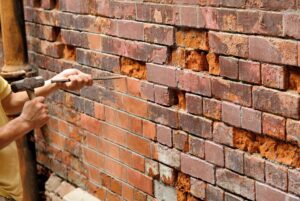
- Tuckpointing: When mortar joints have cracked or deteriorated, tuckpointing restores structural integrity without disturbing the surrounding masonry.
- Stone and block resetting: Loose or shifted facing can often be re-secured and realigned rather than replaced entirely.
- Partial rebuilding: Sections that have bowed, cracked, or separated beyond repair are rebuilt with proper reinforcement and updated backfill.
- Drainage correction: Clogged or missing drain tile is one of the most common reasons frost heave damage keeps coming back. We address it as part of the repair, not as an afterthought.
- Full reconstruction: When a wall has failed at the footing level or was never built to last, a complete rebuild is sometimes the only fix that holds. We handle that too.
Whatever the wall is made of and however it failed, we’ll tell you honestly what it needs.
Get a Free Estimate Before Summer
Frost heave damage doesn’t improve on its own, and another Illinois winter will pick up right where this one left off. The sooner a damaged wall gets assessed, the more options you have.
Request a free estimate and we’ll take a look before the damage gets ahead of you.