Quick Summary:
Cracks above windows and doors in older brick homes are almost always a lintel problem rather than a foundation issue. Steel lintels corrode over time, expand as they rust, and push the surrounding brick out of alignment. The damage is easy to misread as settling or a foundation problem, which leads homeowners to the wrong contractor first. Left unaddressed, water gets behind the wall, freeze-thaw cycles widen the crack each winter, and what started as a manageable repair becomes a wall rebuild. Force Masonry has been diagnosing and repairing this kind of damage across Central Illinois since 2009, with 120 combined years of masonry experience and an A+ BBB rating.
Why Brick Cracks Above Windows and Doors (And What to Do About It)
A crack running above a window or door frame is easy to misread. Most homeowners assume it is a foundation issue or normal settling and either ignore it or call the wrong contractor. By the time the right person looks at it, the damage has usually spread.
The source is almost always the lintel, the steel or stone beam that spans the opening above a window or door and carries the weight of the brick above it. When the lintel begins to fail, the brick shifts with it. The crack is the first sign, but it is not the problem itself.
How Steel Lintels Fail and Why Brick Cracks Above Openings
Steel lintels are built into brick walls at every window and door opening. Their job is to carry the load of the masonry above the gap, transferring that weight to the brick on either side. When a lintel is working correctly, the brick above it stays tight and level. When it is not, the brick has no support and begins to move.
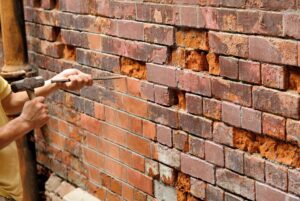
Steel corrodes over time, especially in older homes where the lintel was installed without a protective coating or where water has been getting in through deteriorated mortar joints. As the steel rusts, it expands. That expansion puts outward pressure on the surrounding brick, pushing the mortar joints apart and cracking the courses above the opening. The longer it goes, the wider the crack gets and the more brick gets pulled out of alignment.
Peoria’s North Side and Springfield’s older residential neighborhoods near the capitol are full of brick bungalows and two-flats built in the 1920s and 1930s. The steel lintels in those homes are now a century old in many cases. That is not a worst-case scenario. It is just where the math lands for a material that was never meant to last forever.
Why This Gets Misread as a Foundation Problem
When you see a crack above a window, the natural instinct is to worry about the foundation. It looks like settling. It looks structural. That assumption leads a lot of homeowners through a full foundation inspection before anyone looks at the lintel, and the crack is still there when it’s over because the two problems have nothing to do with each other.
Foundation contractors work below grade. A failing lintel is a masonry problem that lives at the opening itself, and the repair involves removing the damaged brick, pulling the old lintel, and relaying the courses above it. A foundation company is not equipped for that work and is not looking for it during an inspection.
If the cracking sits right at the window or door opening and follows the line of the arch, the diagnosis starts with the masonry, not the foundation.
What Happens When Lintel Damage Goes Unaddressed
The steel keeps corroding, the expansion continues, and the brick above the opening keeps moving.
What starts as a hairline crack becomes a gap wide enough to let water in behind the wall. In a Central Illinois winter, that water freezes. The freeze-thaw cycle widens the crack, loosens surrounding courses, and works through the mortar joints around the opening. Each season leaves the affected area larger than it was.
Left long enough, the brick above the opening begins to bow outward. Rebuilding a bowed section of wall is a significantly larger job than addressing a cracked lintel early.
Why Force Masonry Is the Right Call for Brick and Lintel Repair
Lintel repair is masonry work. It requires someone who understands how brick walls are assembled, how to remove and relay courses without compromising the surrounding structure, and how to match existing brick and mortar so the repair does not stand out against a wall that has been weathering for decades.
Force Masonry has been doing this work across Central Illinois since 2009. The crew brings 120 combined years of masonry experience to every job, which means the person assessing your wall has likely seen this exact problem dozens of times in homes like yours. That depth of experience is what separates a clean, lasting repair from one that needs attention again in a few years.
Force Masonry is A+ rated and accredited by the Better Business Bureau, a reflection of how the company has handled its work and its customers over 16 years in business. Request a free estimate online and get the right eyes on it before the damage spreads.